2025
Prosthetics
Co-founded an open-source, low-cost prosthetics initiative to expand access to customized lower limb prosthetics for children in low-income communities worldwide.
UnLIMBited Prosthetics is a student-led social venture co-founded in 2025 to tackle the global prosthetics accessibility crisis. Over 60 million people live with limb loss worldwide, yet only a fraction have access to devices due to prohibitive costs ($20K–$100K per prosthetic) and lack of local expertise.
As Co-Founder, I lead the design and development of an open-source, 3D-printable below-knee prosthetic system. The platform connects lower-limb amputees with a distributed network of volunteer 3D printers for local fabrication and delivery — dramatically reducing cost and delivery time.
I developed CAD-based prosthetic designs in Onshape with automated resizing and customization driven by user-specific limb measurements. The project involved iterative design refinement in collaboration with mechanical engineers, makerspace leaders, and three licensed prosthetists.
Awarded a $3,750 GTF Seed Funding Grant by National Geographic — selected as the one student chosen from Monta Vista High School by teacher Kavita Gupta.

Role
Co-Founder & Lead Designer
Duration
2025 – Present
Year
2025
Tech Stack
"Built locally, shared globally, made for real lives."
01 — The Problem
The Gap.
Over 60 million people live with limb loss worldwide — yet only 5 to 15 million have access to prosthetic devices. A single lower-limb prosthetic can cost anywhere from $20,000 to $100,000, and in many low-income regions, trained prosthetists simply don't exist.
60–65M
People worldwide living with limb amputation
1M+
Amputations every year — one every 30 seconds
5–15M
People who actually have access to prosthetics
$20K–$100K
Cost of a single commercial lower-limb prosthetic
0
Trained prosthetists in many low-income regions
∞
Growing children outgrow prosthetics repeatedly
02 — Our Solution
End-to-End Platform.
UnLIMBited combines open-source CAD design, 3D printing, and a volunteer-powered distribution network into one centralized platform — delivering a customized, functional prosthetic at a fraction of traditional cost.
Request
A user visits the platform and submits basic measurements of their residual limb.
Customize
Measurements are entered as parameters into our system, which auto-resizes the base CAD model to fit the individual.
Connect
A trained volunteer near the user is matched through the platform to print and assemble the device.
Deliver
The finished prosthetic is delivered locally, reducing shipping costs and increasing speed.
Grow
Users and volunteers share the platform, expanding the network and reaching more people over time.
03 — The Device
What We Build.
A below-knee (transtibial) device inspired by the open-source Limber prosthetic, built entirely from 3D printable components and accessible materials.
Component
Socket
Rigid outer shell with silicone lining for comfort and suspension; slit-based flexibility similar to ski-boot tightening for adjustable fit.
Component
Pylon / Calf
Structural core using advanced lattice infill structures (gyroid, diamond/Schwarz-D) to balance strength, weight, and pressure distribution.
Component
Foot
Flexible TPU construction with heel compliance to allow natural rolling motion during walking; energy return properties built into the keel.
Component
Liner
Silicone mold (~6mm thickness) to cushion the residual limb and reduce pressure points.
Component
Straps
Velcro and adjustable strap system for secure suspension and daily wearability.
Materials Used
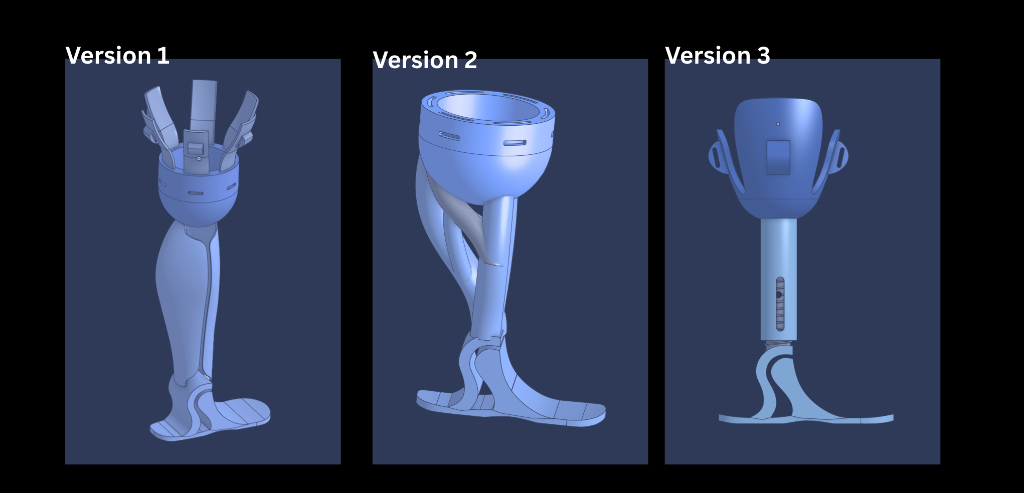
04 — Design Evolution
Three Versions.
Each iteration incorporated clinician feedback, structural testing, and material research — refining fit, durability, and printability.
05 — Design & Engineering Process
How We Built It.
Conducted extensive background research on prosthetic anatomy, socket design, materials, and assembly.
Analyzed existing open-source designs including e-NABLE and Limber for design benchmarks.
Built full CAD model in Onshape, designing each component separately for modular customization.
Iterated through multiple design versions based on structural feedback and self-testing.
Consulted with certified prosthetists and orthotists at Pacific Valley Medical Prosthetics, Applied Clinic, and Berke Clinic.
Incorporated clinician feedback on socket trimlines, pylon diameter, heel flexibility, and suspension systems.
Began physical prototyping and printing at MakerNexus using PLA and TPU filaments.
Developing parameter-based customization system to auto-scale designs from user measurements.
Research
Anatomy & materials
CAD Design
Onshape parametric
3D Printing
PLA & TPU filaments
Iteration
Multi-version design
Clinicians
3 licensed prosthetists
Customization
Parameter-based scaling
Testing
Structural validation
Open Source
Global accessibility
Ideation
Design thinking process
Community
Volunteer network
06 — Stanford Design Thinking Framework
The Framework.
This project follows the Stanford d.school Research and Design Framework, emphasizing real human experiences, defining structural challenges, and testing solutions within communities.
Step 01
Empathize
Listened to amputees, caregivers, and clinicians in underserved communities to understand how inaccessibility showed up in real life.
Step 02
Define
Identified the gap — traditional prosthetics cost $20K–$100K; many communities have zero access to fitting or follow-up care.
Step 03
Ideate
Explored 3D-printable designs, open-source models, and low-cost materials reproducible locally without specialized equipment.
Step 04
Prototype
Designed and printed functional prototypes using Onshape, Fusion 360, and Comb3D — iterating on fit, durability, and comfort.
Step 05
Test
Gathered feedback from users, physical therapists, and community partners to evaluate which designs were practical and effective.
Step 06
Impact
Published all designs open-source, enabling communities worldwide to download, adapt, and print locally.
07 — Clinician Feedback & Validation
Expert Validation.
Peter Ho
Pacific Valley Medical Prosthetics & Orthotics
Recommended gel liner suspension system, confirmed memory foam viability, introduced COMB scanning software and Ossur design tools, provided standard sizing measurements including MPT-to-floor, circumference intervals, and pylon diameter ranges.
Jonathan Smith
Applied Clinic
Advised on load distribution, pressure-relief zones, micro-adjust strap systems, sleeve suspension, and fail-safe retention mechanisms.
Gary Berke
Berke Clinic
Recommended Polycam LiDAR for 3D scanning, variable-stiffness socket walls, ski-boot tightening mechanisms, torsion-damping elements, and energy return keel design.
Emily Nelson
Pacific Valley Medical Prosthetics & Orthotics
Recommended PETG and thermal plastics for socket printing with a fiberglass/UV-resin exterior for durability. Advised on gel liner suspension, Y-strap options, and pressure distribution principles. Outlined a clinical 3D-print workflow for test sockets and explained L-code billing structure for preparatory, test, and final sockets.
08 — Key Milestones
The Journey.
Completed foundational research on prosthetic anatomy, materials, and manufacturing
Designed and iterated full CAD model in Onshape (socket, pylon, foot, flaps)
Consulted with 3 licensed prosthetists for clinical validation
Began physical prototyping with PLA and TPU at MakerNexus
Awarded $4,000 grant from National Geographic's Global Talent Fund Seed Funding Program
Launched website, Instagram, LinkedIn, and TikTok presence
Reached out to 20+ amputee organizations and sponsor prospects
Submitted applications to Diamond Challenge, Blue Ocean, and ExploraVision competitions
Developing parameter-based CAD customization system
Recruiting volunteers and building distribution network
Pursuing 501(c)(3) nonprofit registration
09 — Impact Goals
Where We're Headed.
100 Devices
Distribute 100 3D-printed prosthetic devices by end of 2026.
Global Network
Build a self-sustaining volunteer network of makers and recipients worldwide.
Fully Open-Source
Open-source all CAD files, printing guides, and assembly instructions.
Partnerships
Establish partnerships with clinics, nonprofits, and disability organizations.
Zero CAD Barrier
Create a scalable customization pipeline requiring no CAD experience from the end user.
10 — Skills & Technologies
What Was Used.
CAD Design
Onshape — full parametric multi-component assembly
3D Printing
FDM printing with PLA, TPU; printing at MakerNexus
Materials Research
PLA, TPU, PETG, silicone, memory foam — tested and selected for function
Biomechanical Research
Socket design, load distribution, pressure mapping, FEA concepts
Clinician Outreach
Formal consultations with 3 licensed prosthetists
Platform Development
Wix website with volunteer/recipient platform structure
Social Entrepreneurship
Grant writing, competition pitching, TAM/SAM/SOM analysis
Community Building
Social media growth, email outreach to 20+ orgs, nonprofit registration in progress
11 — Pitch Decks & Video
The Pitch.
Explore our pitch decks and presentation video submitted to competitions and grant programs.
Pitch Deck 1
Diamond Challenge submission deck
Pitch Deck 2
Blue Ocean competition deck
Pitch Video
Full presentation video
Update the links above in the source data once your decks and video are hosted.
12 — Connect With Us
Follow the Mission.
Stay up to date on prototypes, milestones, and the communities we're reaching. Every share expands our network and gets us closer to the next person who needs a prosthetic.
Note: This project was kickstarted through my Interdisciplinary Research and Design Class at Monta Vista High School, visit our website here: https://irpdelders.wixsite.com/irpd !
@unlimbitedprosthetics
@unlimbited0
UnLIMBited Prosthetics
unlimbitedprosthetics.com
UnLIMBited Prosthetics · 2025–2026
Engineering movement, together.
Every prosthetic is more than a device — it's a step reclaimed, a life expanded, a future made possible. We're just getting started.
Visit unlimbitedprosthetics.com
